A physicist at the University of Jinan in China has published an argument that, across a wide range of theoretical universes, a traveller cannot return to their own past. Hongsheng Zhang's case rests on a single property of light and runs to roughly three lines of mathematics, according to Euronews.com, which interviewed him about the work. The paper has been submitted for peer review.
The question Zhang addresses is narrower than the familiar science-fiction premise. Rather than asking whether time travel is possible in general, he examines when the geometry of a given universe rules out a closed loop — a path through space and time that arrives back at its own starting point.
Why it matters
Physicists have long known that Einstein's equations permit such loops in a few special settings, most notably near the core of a rotating black hole. Working out which universes allow them, and which do not, helps clarify whether the prohibition on travelling backwards is a fundamental law or merely a feature of the spacetimes we happen to inhabit. Zhang is explicit that his result is not a blanket denial. "This is not a claim that time travel is impossible," he told Euronews.com.
The staircase argument
The core of the argument is that light never travels at an angle to a traveller's direction in time. Zhang's phrasing, as quoted by Euronews.com, is that light can never point sideways to that direction.
From this, he builds a picture of spacetime divided into surfaces that light itself can follow. Anything moving more slowly than light has to pass through those surfaces in one consistent direction, the way a person climbing stairs can only keep going up. If every step must be taken upward, no route leads back to the step where the climb began.
That reasoning covers a broad class of universes. Physicists refer to a route into the past as a closed timelike curve. To shake hands with your younger self, as Zhang puts it, you would need a path that loops back on itself while staying at or below the speed of light.
Two ways around the barrier
Zhang's analysis also identifies the only two circumstances in which the staircase picture breaks down.
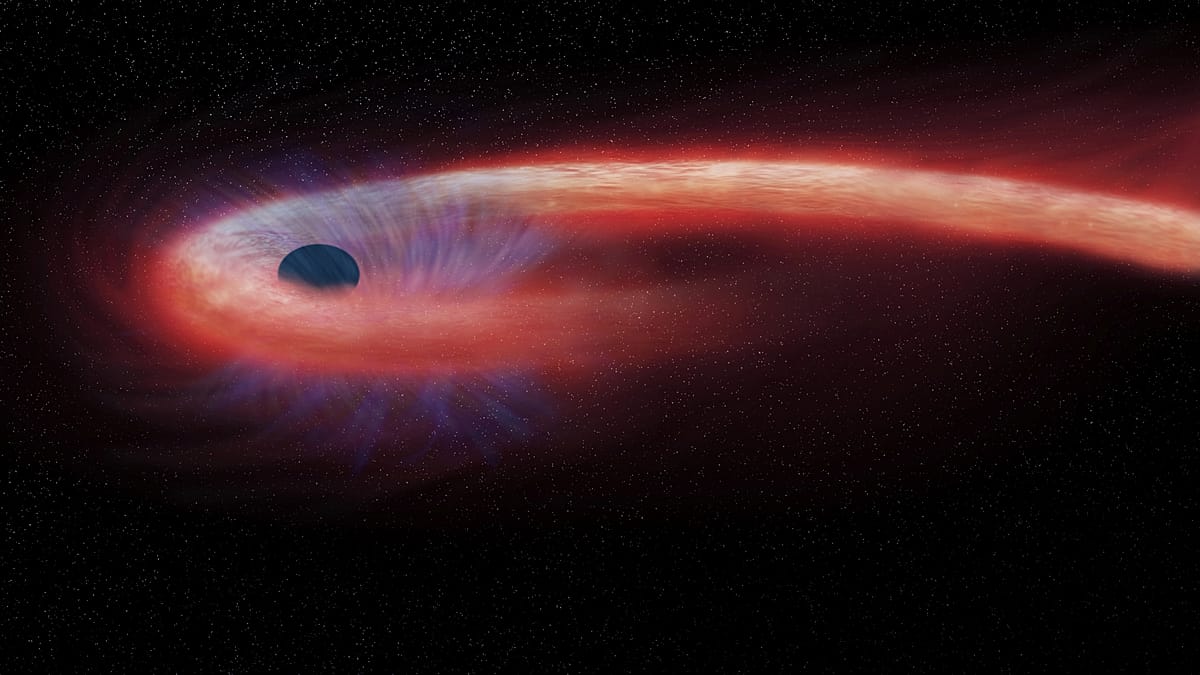
The first is twist. If light rays spiral around one another rather than running parallel, the clean surfaces cannot form, and the one-way staircase disappears. This is what Einstein's theory describes near the centre of a spinning black hole, where the rotation drags space and time so strongly that moving forward in time curves into a circle. A traveller on that circle would experience their clock running normally while arriving back at the moment of departure. The physicist Brandon Carter demonstrated in 1968 that such loops exist inside rotating black holes.
Zhang is careful to separate twist from the loops themselves. Twist alone does not produce a closed curve, he told Euronews.com; it merely prevents his argument from applying. Twist is common throughout the universe and, on current knowledge, harmless.
The second escape route is the overall shape of the universe. The staircase could be soundly built yet wrap around a structure so that the highest step meets the lowest — the kind of impossible architecture found in M. C. Escher's drawings. A climber would keep ascending and still finish where they started. Most time machines physicists have sketched on paper, wormhole-based designs among them, depend on this property, which researchers call topology.
Zhang regards topology as the loophole worth watching, while noting it is also the one least likely to occur without deliberate construction.
Forward travel is already routine
Movement toward the future is on firmer ground. Einstein's work established that fast motion or strong gravity slows a clock relative to clocks elsewhere. According to the European Space Agency, astronauts back from a six-month stay on the International Space Station are about five thousandths of a second younger than they would otherwise have been.
Zhang's paper now awaits peer review, and scrutiny from other physicists will determine whether the staircase argument holds across the full range of spacetimes it claims to cover.